





How does an offhand comment from a fellow cyclist spark a fire that becomes a worldwide phenomenon? To find out, I talked with Sema Gür, the woman who fanned that flame.
As a child, Sema dreamed of having a bike, a bright red one. She remembers playing on a borrowed tricycle. When her father explained he’d have to give it back at the end of the day, she protested, making a sudden break for freedom. Her seven-year-old legs pedalled furiously until her laughing father caught up and managed to wrest the tricycle from her clutches.
As an adult, teaching history at an Izmir high school, she was persuaded by her colleague, Filiz, that she should join a group of enthusiastic cyclists touring the countryside around Izmir every weekend. The problem was that Sema had never learned to ride a bike, and wondered if she could. She was 37 when she asked her long-suffering father to teach her – on a two-wheeler this time, also borrowed. A few weeks later, with much practice and one or two falls, she felt confident enough to consider cycling with her friends on their weekend escapes from the city.
Riding her own bike, red, of course, Sema loved these trips into the countryside. They meandered along quiet lanes between olive groves or narrow roads flanked by old stone houses in out of the way villages. She did find pedalling uphill exhausting, but the exhilaration of freewheeling downhill was worth the struggle. On a busy road the twenty or thirty riders would string out in single file, men in their Lycra shorts and aero-dynamic helmets leading the way.
Which was something that bothered her.
The men leading the ride wanted to go at a fast pace, crouched low over their bikes, heads down, muscles pumping as if in training for a race. The others in the group were left trying to keep up and were not always given enough time to catch their breath at a rest stop.
One day Sema tentatively asked, “Perhaps, sometimes, the ride could be a little slower?”
“If you can’t keep up with the men, go cycling on your own!” was the reply.
This was the spark.
Later that week, over the noise of a crowded coffee shop, Sema and her female friends discussed the remark. They were offended.
“Surely cycling doesn’t always have to be a tough sport, or a competition. Our weekend trips should be fun.”
“And women should feel confident about joining cycling groups, or even just riding to work each day.”
“So what’re we going to do about it?”
There was a pause and then a rush of suggestions.
“Here’s an idea. There’s something called World Car-free Day every September. It’s a day to enjoy the peace and quiet of city streets free of traffic. Why don’t we join in? Invite our women friends to cycle together on that day?”
“We could meet up somewhere on the waterfront.”
“Let’s tell everyone to dress up and decorate their bikes. We’ll attract the attention of motorists that way.”
“Women on bicycles!”
“If we wear bright clothes, everyone will notice.”
“And it’ll be fun!”
And so the first Süslü Kadın Bisiklet Tur, Fancily-dressed Women’s Bike Ride, was launched. There was no detailed organisation, no carefully laid out plans, just a few WhatsApp and Facebook posts – more of a spontaneous party on wheels.
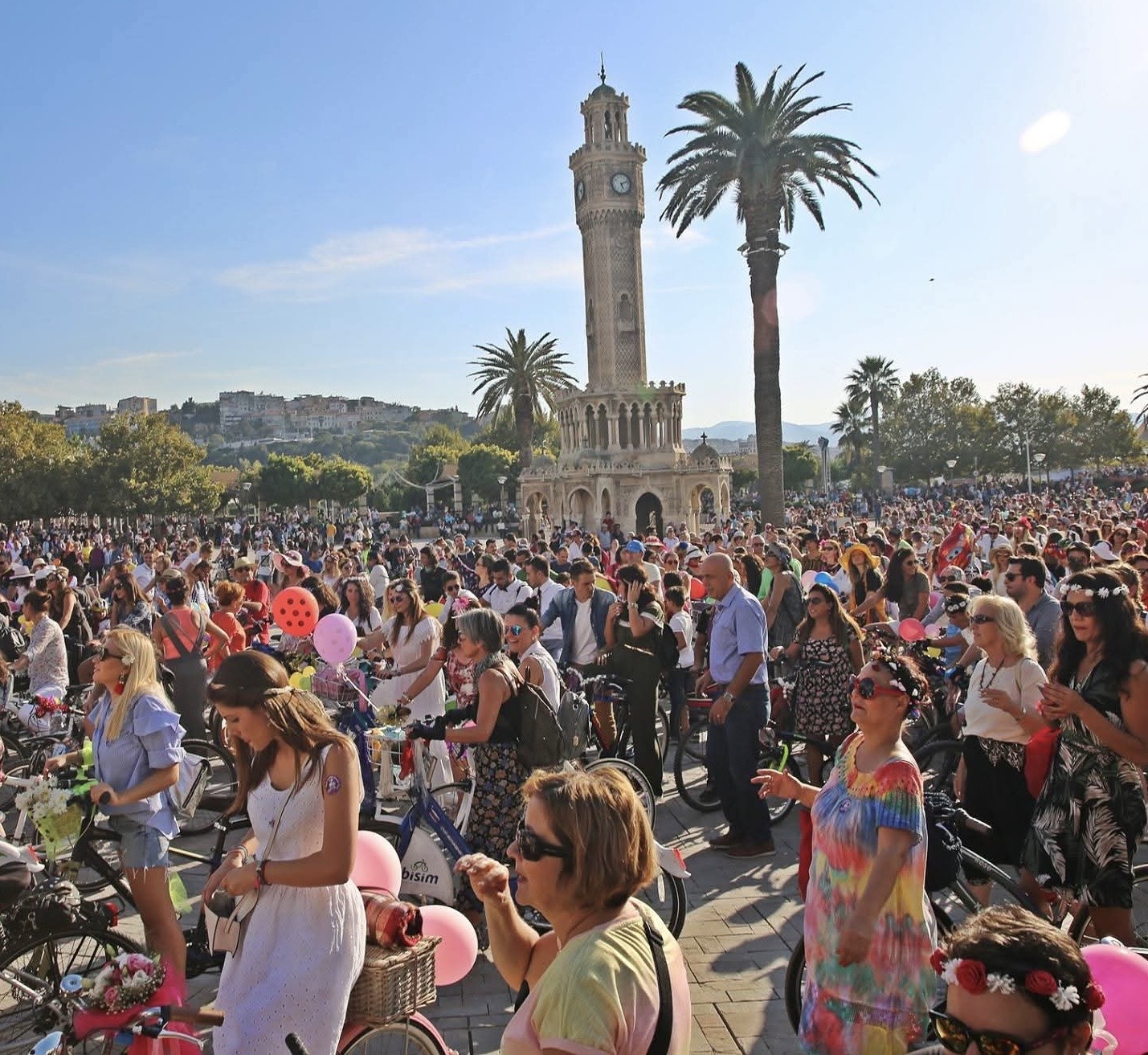
On the chosen Sunday afternoon, Sema and her friends gathered beneath the Konak clock tower, a well-known meeting point. They were expecting about ten or fifteen people to join in. But as they waited the slow trickle of women cycling into the square became a cascade of colour: flowers garlanding heads, hats and handlebars; colourful balloons matching vivid summer dresses; necklaces, pendants, even some stiletto-heeled shoes. Sunday runners, other cyclists and dog walkers along the waterfront, looked with interest at their eye-catching attire and elaborately adorned bikes. By the time they were ready to start, at least 200 women had filled the square.
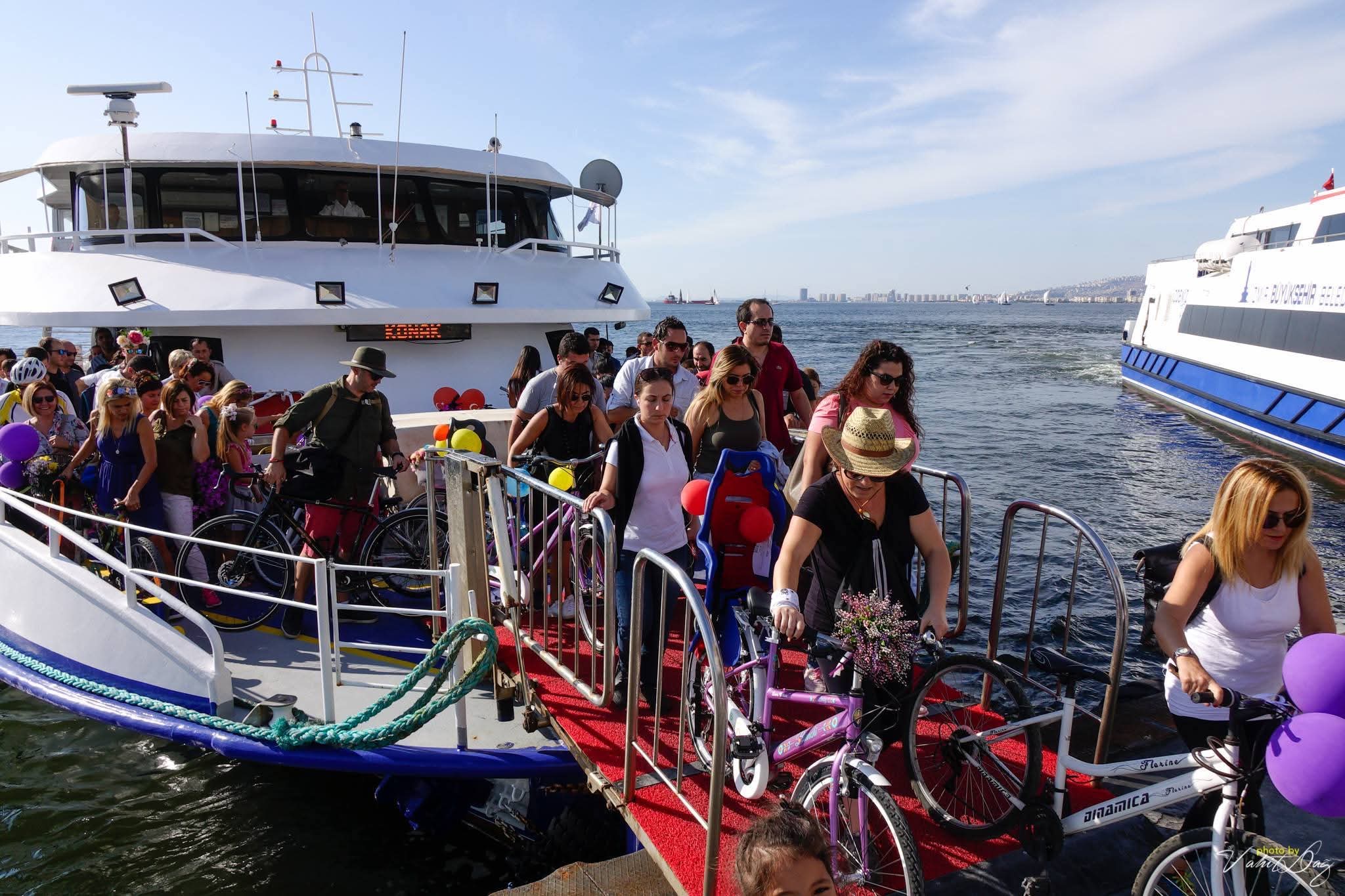
The sight of so many women joining the ride was beyond Sema’s expectations and she was nervous as she led the group onto the bike path to cycle towards the centre of Izmir. She had no permission from the authorities for so many people to meet, there was no first aid kit if someone fell, and no plan for how to end the ride. Was she perhaps expected to make a speech to the crowd? Photographs of that day show a very serious Sema, suddenly responsible for leading the laughing, smiling, waving group on their first Fancily-dressed Women’s Bike Ride. When they finished, Sema shared a few words of thanks with everyone, then she and her friends converged on the nearest bar. In loud excited voices, they discussed what had just happened. Inspired by so many women cyclists showing up, encouraged by the enthusiastic participation and happy that it had gone so well, they started throwing out ideas for the next year and how they could have even more women take part.
“Wait,’ said Sema, ‘we’re getting carried away. This was supposed to be once only. What if next year four hundred women turn up? We’d need to organise, get a permit and…”
No one paid attention to Sema’s concerns. The event was a huge success. Of course they should do it again. Unconvinced, but reluctant to dampen the others’ high spirits, Sema was wondering if they’d been noticed.
Noticed? Within days there were reports in local newspapers, articles in cycling magazines, TV interviews, posts and photographs tagged on Facebook, shared on Instagram, messages, emails, phone calls from women all over Turkey excited to hold their own Fancily-dressed Women’s Bike Ride.
Faced with this explosion of questions and requests for information, another cyclist friend, Pınar, helped set up a website to offer explanation, guidance, and inspiration. They hoped women would stick to the spirit of the ride, which was to normalise cycling for women, to make it accessible to all, including men riding slowly at the back of the group in smart jackets, ties and stylish hats. And have a good time! Importantly, groups shouldn’t accept financial support, such as business sponsorship and advertising, or have ties to other organisations.
Sema wasn’t to know this ride would be a part of her life for the next 10 years. To her astonishment, year by year the number of women taking part began to spread across Turkey – from Kuşadası to Konya, Marmaris to Mardın – until by 2016 in as many as 50 towns and cities across Turkey women were organising their own fancily-dressed cycling event on the same day every September. Interest also spread beyond Türkiye into Europe and then to countries all over the world. The number of women participating was startling. Over 10 years the movement grew from 200 participants to nearly 50,000 in 30 countries.
Pınar and Sema had never imagined what was to follow; invitations to present at TED Talks, to contribute to a UNESCO panel on cycling alongside UN ambassadors, and recognition for being the most successful grassroots movement of the year. Finally in 2022, they were presented with a United Nations World Bicycle Day Special Award in recognition of their ‘leadership and excellence in promoting cycling.’
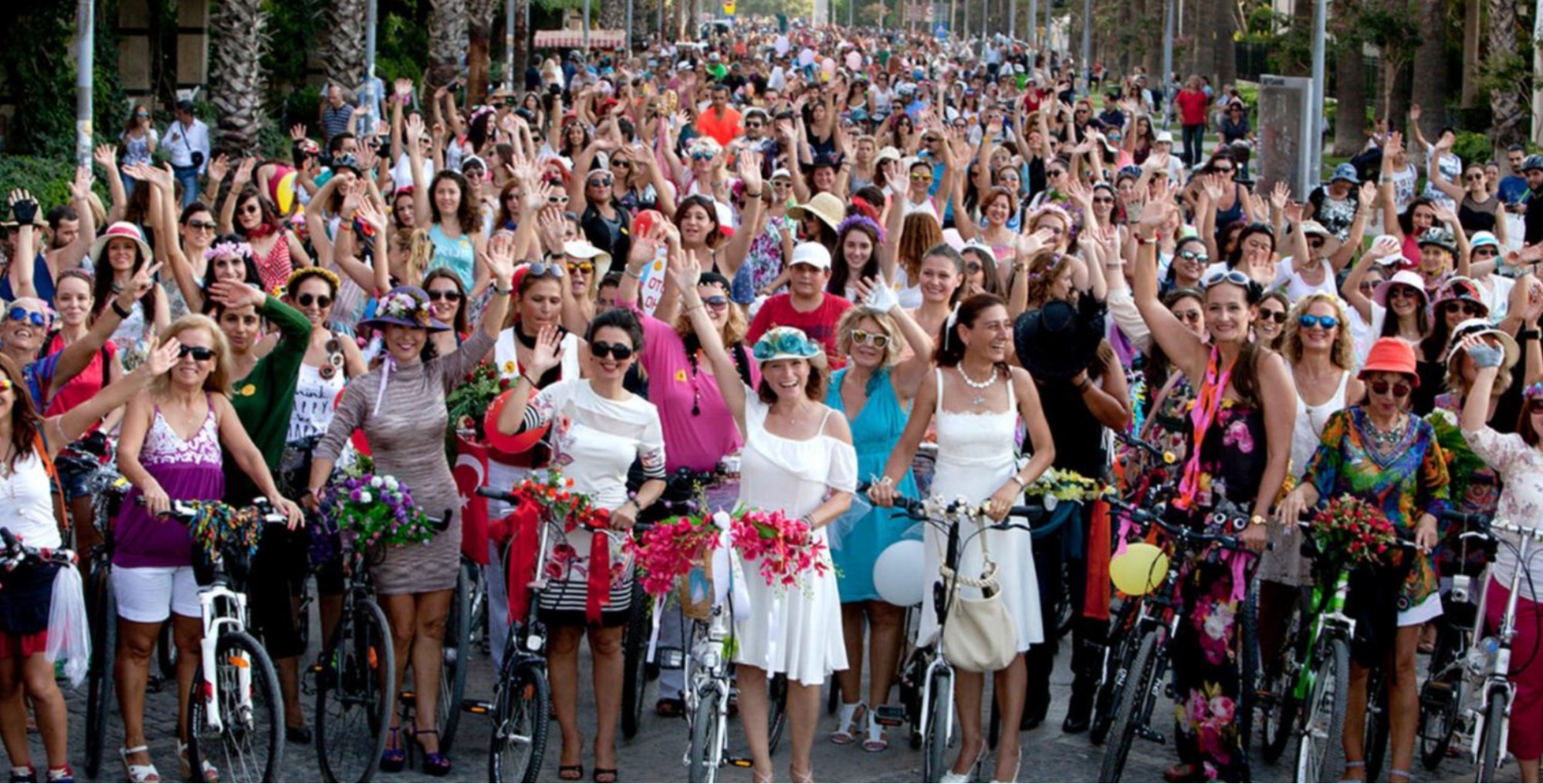
After all this remarkable achievement, in 2023, Sema and her friends made a surprising announcement – the Fancily-dressed Women’s Bicycle Ride that year would be the last. Why, I asked Sema, did she make this decision?
“Partly because it had become such a large-scale event needing a massive effort from volunteers. By the end we were arranging new locations, schedules, permits, stage and microphones for live music, and food stands at the end of the ride. That was hard to do when we all had full-time jobs. But mainly because the spirit we’d created was well and truly alight and we knew it would continue, with or without us.”
Sema cycled away from our interview on her bright red bicycle, in a matching coat with an extravagant white bow tied behind her saddle. She’s still drawing attention to women on bikes!
For more information on Sema Gür’s movement be sure to visit https://suslukadinlarbisikletturu.com/ and https://fancywomenbikeride.com/.