





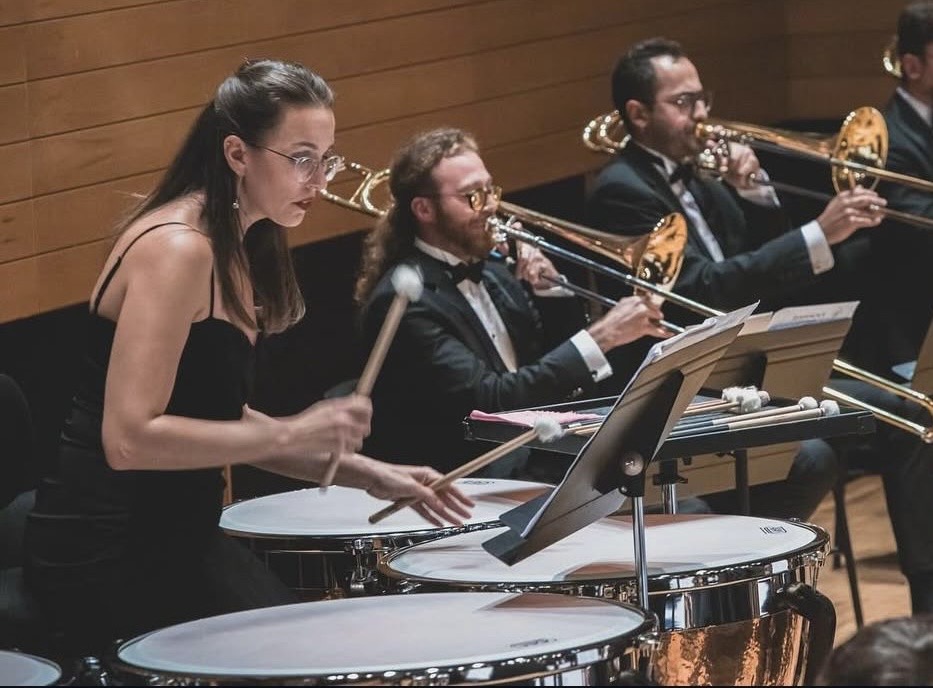
Whenever I see Özgecan Arın she’s in costume, a long black evening gown complementing her height as she steps elegantly up to the top tier of the orchestra, settling in behind her musical instruments, face serious, ready to focus on her performance. She’s a percussionist in the İzmir State Symphony Orchestra, the only female in her group of four, I’m just one part of the audience. I’ve never met her but I recognise her tall figure as she makes her way around the line of customers in a busy coffee shop. She’s casually dressed in jeans and a soft beige coat, hair tied back, wearing rimless glasses and a broad smile as she shakes my hand. We make our introductions as we sip our coffee.
I wasn’t surprised to learn that growing up in a musical and theatrical family, Özgecan was interested in performance. As a child, she dreamed of becoming a ballerina. She loved dancing whether the music playing at home was jazz or rock, folk or pop, Turkish or Western classical music. “I developed a feeling for the rhythm underlying the music, not just the regular beat,” she said.
However, she soon grew beyond what was then an acceptable height for a ballet dancer. “I don’t remember being upset by that,” she said. “Instead, I asked my parents if I could start piano lessons.” She laughed. “I was really keen to learn but I didn’t like spending time on practicing. At ten years old, I didn’t have enough self-discipline. Anyway, soon after, I joined the Symphony Orchestra Children’s Choir with a friend, and that suited me better. A teacher with the choir suggested I should apply to the Conservatory High school.” From there, Özgecan moved on to the İzmir Conservatory at 9 Eylül University.
“Even then, I wasn’t committed to playing any particular musical instrument until one morning before class, Murat Bey, a teacher who knew I was undecided, shook my hand and said, “You could try percussion. With your long fingers and broad handspan, you might make a good percussion player.”
Özgecan was intrigued by this suggestion and felt confident that her interest in learning to play percussion instruments would last longer than her piano lessons. Little did she realise that this handshake was the start of a successful, professional career.
Now, of course, she knows identifying a potential percussion player by hand strength alone, probably isn’t the best selection technique! Flexibility, good hand-eye coordination and lightning-fast reflexes, are as important as strong hands alone.
“Strength is sometimes needed,” she smiled. “It’s a full team effort to move a heavy bass drum or timpani from one level to another. Of course, good control of arm muscles is an absolute necessity when playing the full range of instruments, agility and dexterity, too. You have to be a well-trained athlete with the stamina of a long-distance runner. Another important skill, that perhaps isn’t always considered, is the ability to work closely with my fellow percussionists. When we’re playing different instruments at the same time, the weave in our playing should be flawless, but also invisible.”
Özgecan has the same rigorous training all musicians undergo whether it’s music theory, sight-reading skills, hearing and distinguishing tempo and rhythm, technique and interpretation, focus and timing. “At the same time, I’m mastering many different and demanding techniques. Percussion playing in a symphony orchestra is not just about the drum kit!”
She pauses, puts down her coffee cup and looks at me, sensing my lack of musical understanding.
“It’s not as simple as striking an instrument at the right moment. And percussion isn’t always loud and dramatic. While you’re hearing the bell-like sound of the glockenspiel or even the ringing of a triangle, I’m using my understanding and interpretation of both the instrument and the music to get the right sound, the right resonance. My skills and finesse are as highly developed as any other musician.”
“What about rhythmic sounds in your daily life?” I ask. “When you notice a rhythm – the click of tram wheels, the clatter of the metro as a train arrives, the regular beat of windscreen wipers?”
She’s smiling now. “I can’t stop myself from unconsciously counting the beats and producing music in my head. That’s not always a bad thing, but at night, if I detect the faint rhythm of a ticking clock, it’s terrible! I have to get up and remove the batteries otherwise there’s a concert going on all night and I can’t sleep.”
In any performance there are times when the percussionists might sit for a long time with nothing to do. I wonder if she’s listening, or is she just relaxing?
“I never sit there, empty-headed. The role of a percussionist is not a decorative one. There’s a reason I’m sitting. I’m actively waiting.” She has a serious look on her face as she explains. “I’m following the music, surrendering to the rhythm, the phrasing, focusing completely. I disappear into the music. I feel the emotion, I might even cry. If there’s a gap in my mind, how can I step back in and engage fully with the other musicians?”
“It must be a challenge for the orchestra to synchronise their playing to the demands of a different conductor or soloist each week. How does a foreign conductor communicate their vision of the symphony to an orchestra they’ve never met before, especially when they don’t share the same language?”
“Well, first of all, the orchestra comes to the rehearsals knowing the pieces we’re going to be playing inside out. The rehearsal is for the conductor to show us their interpretation of the music and where we try to achieve that.”
“How does that happen? What’s the process?”
“The score for the next concert is given a week in advance. I read it, trying to get the feel of the composer’s intent. I listen to several different recordings, absorbing the timing and the phrasing, and then practice so that I not only know every note, but also exactly how those notes should be played.”
“And do you practice at home, too?” I ask, wondering how her neighbours react to the sound of cymbals echoing through her apartment building.
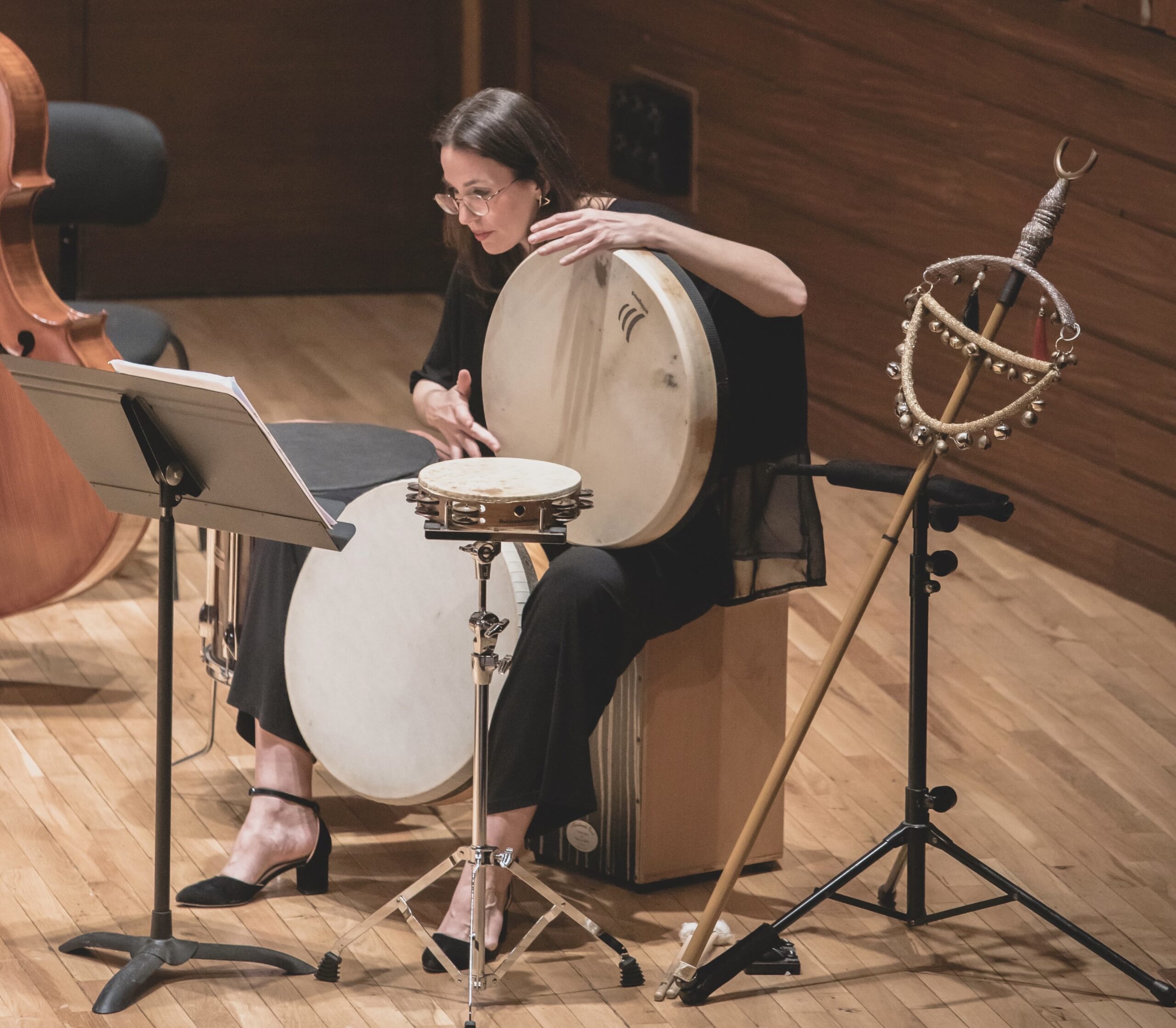
She laughs. “Not really. My instruments are, let’s say, fundamentally incompatible with apartment living! I don’t have instruments that I can carry home,” she continues, “like a violin or a flute, so I either put on my earphones and practice on an electronic pad or, if my part involves multiple instruments, I go to my workplace, at the symphony concert hall.”
“So when you first meet the conductor for rehearsal, you have your own understanding of the symphony you’ll be playing. Then what happens?”
“The conductor explains their ideas to the musicians. We rehearse elements, such as the phrasing, tempo, volume, cohesion, until the conductor is satisfied their vision for the piece has been achieved. I enjoy those conductors who express themselves lyrically or poetically with ‘Just imagine…’ When I can see an image, I can hear the sound they’re after, hear the music in my head the way they want it played. I love this process. It’s a continuous learning experience.”
“During a concert,” I say, “I always feel a moment of anticipation as well as tension when you silently move from sitting to standing, your eyes never leaving the score. When you pick up your mallets, preparing for your cue, I know something is about to happen and that expectation is exciting.”
Özgecan smiles at the thought.
“But,” I continue, “there’s a quiet anxiety that sometimes slips into my mind, as a misplaced drum beat can’t be hidden. Have you ever—”
Özgecan laughs and shakes her head as though I was joking. She’s too polite to remind me that as a highly-trained and experienced musician, she doesn’t make amateur errors. But there was a glint in her eye.
“I did once have a problem playing a Ramazan drum, strapped over my left shoulder. There I was in my long black dress, at the front centre stage, all eyes on me when the strap on the drum broke. The drum was heavy and I felt it slipping down towards the floor. Playing with both hands, leading the tempo for the soprano and the orchestra, I began to panic. I stepped back, sat down on a chair behind me, and kept playing until a short pause allowed me to reattach the strap and I could stand up.”
I was fascinated. “And did you manage not to miss a beat?”
She pauses, setting down her coffee cup before she answers. “Of course. I’m a professional. The audience probably didn’t even notice.”
This mention of audience reminds me of their behaviour during a performance. “The Friday evening concert-goers are always appreciative and generous with their enthusiastic applause. But sometimes they can be annoying. You’re up on the stage but do you hear a ringing phone, the crackling plastic of a dropped water bottle? Do you notice people filming, typing into their phones or talking?”
Özgecan sighs. “Absolutely! The audience doesn’t seem to realise the musicians on stage can hear and see all of this. It’s disturbing and breaks the concentration for both audience and orchestra. We find it disrespectful.”
“How do you feel when there’s clapping after each movement, instead of silence until the end?”
“Now that doesn’t bother me. The audience is responding to the beauty or excitement of the moment. But what I would like is a pause, about five seconds, before the maestro lowers the baton at the end. At this point I’m completely immersed in the music. The silence is a magnificent contrast and I need a moment to absorb the feelings and emotions of the piece before the rapturous applause. But whenever it comes, it’s wonderful. How many jobs can you do that applaud you at the end of your working day!”
When I tell her some of the regular concert-goers fondly refer to her as bizim kız, (our girl), she nods. “I know they feel a connection with me. Sometimes they stop me after a concert and compliment my dress or tell me I’m looking too thin!”
I wonder if the connection could be because she’s the only female in her group. “Are you a pioneer, opening the path for other women percussionists?”
“I don’t think of myself as one, although young percussionists sometimes tell me I’m their hero. I’d like to see more females in percussion – it’s happening slowly. But female or male, I want to encourage them all. My passion is reflected in the young percussion students I mentor. That’s my role – older, experienced musicians help the beginners. Your teacher often becomes your colleague like Murat Hocam, our percussionist leader, was mine.”
Özgecan continues, “Playing percussion is part of my whole identity, an extension of who I am. But whichever instrument I played, it would feel the same – contributing to something bigger. I love that feeling, being part of an orchestral team, creating magic together.”
As we end our conversation and say goodbye, I know at the next concert as Özgecan and the musicians in formal evening wear quietly take their places and the audience falls silent in anticipation, I’ll be listening with a deeper understanding of her role in shaping that magic.